
Criminal Court Cases in Mitchell County
North Carolina uses one General Court of Justice, but its two trial divisions do different work in Mitchell County. District Court hears misdemeanors and handles early felony steps, including first appearances and probable-cause process. Superior Court takes felony pleas, trials, sentencing, and related post-judgment matters. Magistrates issue process and conduct initial bond functions within their authority. Their Mitchell County lines are 828-520-1500 and 828-688-5119.
The Clerk of Superior Court is the custodian for both divisions' Mitchell County case records. The clerk's office is at 328 Longview Drive, Bakersville, NC 28705, and answers 828-688-5100 on weekdays from 8:30 a.m. to 5:00 p.m. Spruce Pine and Bakersville do not run separate municipal criminal courts. A city citation or arrest enters the Mitchell County District or Superior Court file, so searching for a town court database leads readers to the wrong place.
Mitchell County Court Division Split
The charge class helps identify the likely division, but it does not tell the whole story. A felony may first appear in District Court before it moves to Superior Court. A misdemeanor normally remains in District Court. Appeals from District Court may produce a Superior Court trial de novo when the law allows, which means the later file may reflect a fresh trial rather than a review of the first result.
The official Mitchell County court contact directory shows the local clerk, district attorney, magistrate, and judge channels. The directory view below helps separate the records desk from offices that take part in the case but do not serve as the clerk's file custodian.
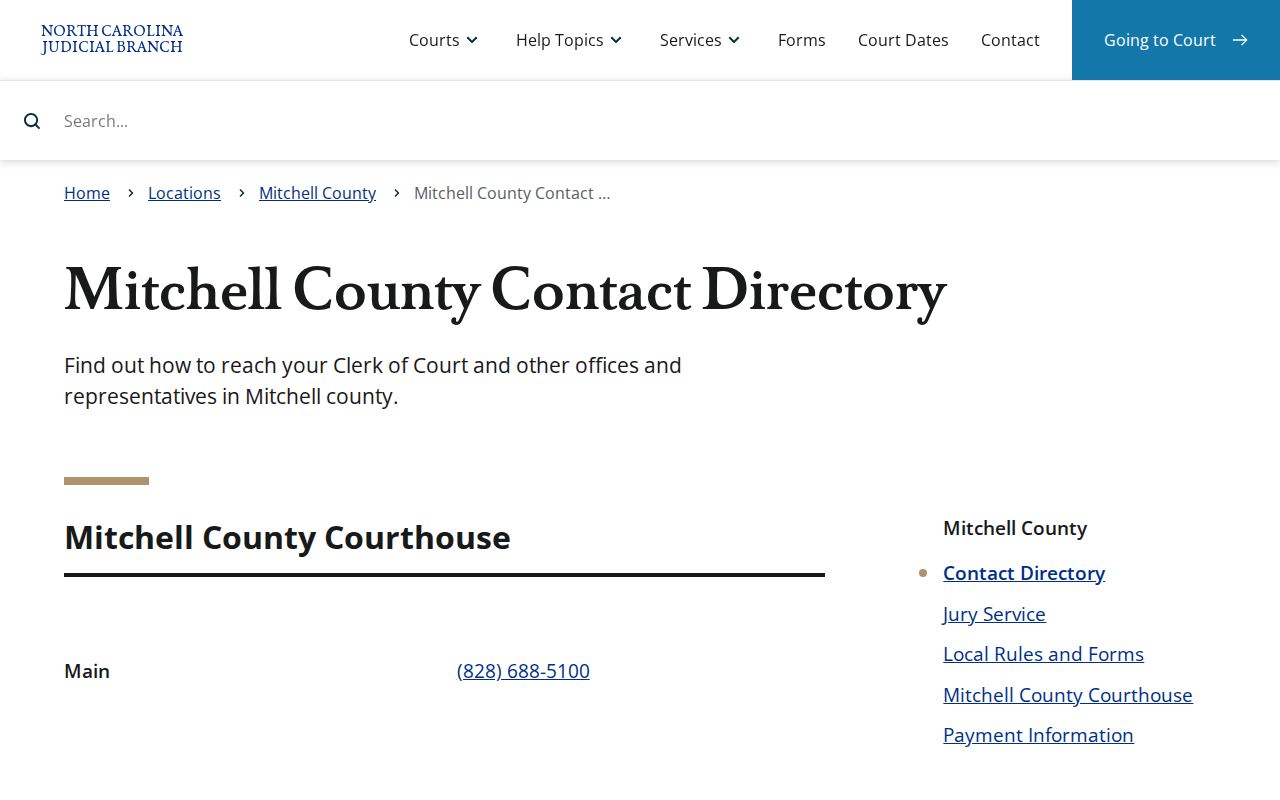
Use the clerk for the docket and copies, the magistrate for initial-process routing, and the district attorney only for the prosecution functions that office performs.
Mitchell County Case Record Searches
The free starting point is North Carolina eCourts Portal. Smart Search accepts a party name or record number, and filters can narrow results to Mitchell County and a criminal case type. Portal became available during Mitchell County's 2025 eCourts expansion. It is useful public information, not a certified court record.
- Open Smart Search and enter the party name or exact case number. A case number is more precise than a common name.
- Use Advanced Filtering Options to select Mitchell County and the criminal case category where those controls appear.
- Compare the case number, filing date, charge, court location, and status. Do not treat a same-name result as proof of identity.
- Open the register or timeline to review hearings, filings, plea or disposition events, judgment, and financial entries that are public.
- Call or visit the Mitchell County clerk for a file inspection, copy, or certified record when the result will be relied upon.
| Portal control | Type | Required | Use |
|---|---|---|---|
| Smart Search | Tab | No | Primary public search route |
| Search Criteria | Text | Yes | Party name or record/case number |
| Advanced Filtering | Expander | No | Narrows broad results |
| Location | Dropdown | No | Select Mitchell County for local cases |
| Case category | Filter | No | Narrow to criminal cases |
| Party/status/date | Filters | No | Availability changes with context |
Search filters reduce false matches, but they do not prove identity. Record the case number and compare the public party, date, location, and charge details before requesting the Mitchell County file.
Mitchell County eCourts Access
The Judicial Branch's eCourts overview explains the statewide electronic case system, which reached Mitchell County in July 2025 and all one hundred counties that October. Its Portal FAQ defines the limits of search results and document access. The captured overview below gives the statewide context for a local Mitchell County court lookup.
The transition improves remote access, yet it does not turn every court document into an online image. Public self-service terminals, clerk staff, paper files, and certified copies remain part of the access chain. Registration or a higher access role may be required for some Portal functions, while ordinary public case information remains searchable without treating the portal as the official file.
Portal events also need context. A listed calendar date shows a hearing was set. It does not prove the hearing occurred or establish the outcome. Open the later events and judgment, then confirm the final disposition with the clerk.
What a Criminal Case File Contains
A Mitchell County criminal case file follows the prosecution, not just the arrest. It may show the filed charge, statute, offense date, attorneys, process and bond entries, hearings, motions, plea or trial result, judgment, sentence, probation, costs, and later compliance events. The arresting officer's original narrative usually remains with the agency that made the report.
| Case header | Case number, Mitchell County location, division, filing date, type, and status |
|---|---|
| Parties | The State, defendant display name, and public attorney entries |
| Charges | Description, statute, offense date, class, sequence, and disposition |
| Process and bond | Process type, issue or service status, and public bond terms |
| Events and hearings | Filings, dates, session, courtroom, and event type |
| Judgment | Dismissal, acquittal, conviction, sentence, custody, probation, and conditions when public |
| Financial entries | Fines, costs, balances, and payments where exposed |
Document images and field detail vary by access level. Use the timeline to locate the event, then request the public filing or certified judgment from the Mitchell County clerk when the exact text matters.
Note: A Portal event list helps locate a filing, but only the clerk can supply the authoritative Mitchell County document.
Mitchell County Charges and Dispositions
The charge shown at arrest is not always the charge prosecuted in Mitchell County court. An officer records suspected offenses based on probable cause. The district attorney then reviews the case and may file, amend, replace, or dismiss counts. Read each charge row with its statute, offense date, class, sequence, and disposition. That pairing shows which accusation the result belongs to.
Several terms carry distinct meanings. A dismissal means the State did not obtain a conviction on that count. Not guilty records an acquittal. Guilty may reflect a plea or verdict, and the judgment supplies the sentence. A pending count has no final result yet. A missing disposition may also mean the report has not reached or linked to the system, so it should not be turned into a conclusion about guilt.
- Arraignment
- The court step at which the charge is addressed and a plea may be entered.
- Disposition
- The recorded outcome for one charge, such as dismissed, not guilty, or guilty.
- Judgment
- The court's formal ruling and sentence after a conviction.
- Trial de novo
- A new Superior Court trial after an eligible District Court appeal, rather than a review of the first trial record.
Compare the final Mitchell County judgment with any arrest record or NCSBI response. The court case is case-based, the arrest report is event-based, and the state criminal history is person-based through fingerprints. North Carolina's structured-sentencing laws supply the classification framework behind many judgment fields. Those sources can differ without any one of them being a full substitute for the others.
Mitchell County Clerk Record Channels
Remote search is only one route. The Judicial Branch court-record access page describes online information, courthouse terminals, paper-file inspection, and copies. The source image below records those channel choices for Mitchell County court case research.
A public terminal at any county clerk's office can search criminal information by defendant name, case number, or victim and witness name. Paper files are inspected where the case is located. If an older Mitchell County case does not appear online, give the clerk the name spelling, approximate year, charge, and case number if known, then ask whether a legacy paper, microfilm, or archive search is needed.
The clerk also offers a certified statewide criminal court-record search for $25. The official clerk search instructions shown here explain that this is a court-index check, not the NCSBI fingerprint repository.
Ask whether a plain copy or certified copy fits the need, and confirm current copy charges before ordering. Certification links the copy to the clerk's official custody of the file. For approved bulk or real-time access needs, the Judicial Branch separately publishes its RPA online-access program and fee schedule.
Criminal Case Stages in Mitchell County
A court file may begin after an officer's arrest, a citation, or judicial process. The district attorney decides what the State files and pursues. That decision can amend, replace, or drop an arrest charge. District Court handles a misdemeanor through disposition, while a felony can move from initial District Court proceedings to the Mitchell County Superior Court docket.
Case flow: Charges Filed › Arraignment › Pretrial › Plea or Trial › Disposition › Sentencing
Read each stage in order. A pending status means the court has not posted a final outcome. A dismissal means that charge did not result in a conviction. Not guilty is an acquittal. Guilty may come by plea or verdict and should be read with the judgment and sentence. A deferred arrangement needs its later compliance and disposition events before its effect is clear.
Note: A scheduled Mitchell County hearing is calendar information until the docket records what occurred and posts any resulting order.
Missing Mitchell County Case Records
A failed online search is not proof that no case exists. The name may be misspelled, the case may be too new for the event to appear, an old file may require a legacy search, or the record may be sealed or confidential. Start by changing as little as possible: try the exact case number, another known spelling, and the Mitchell County location filter.
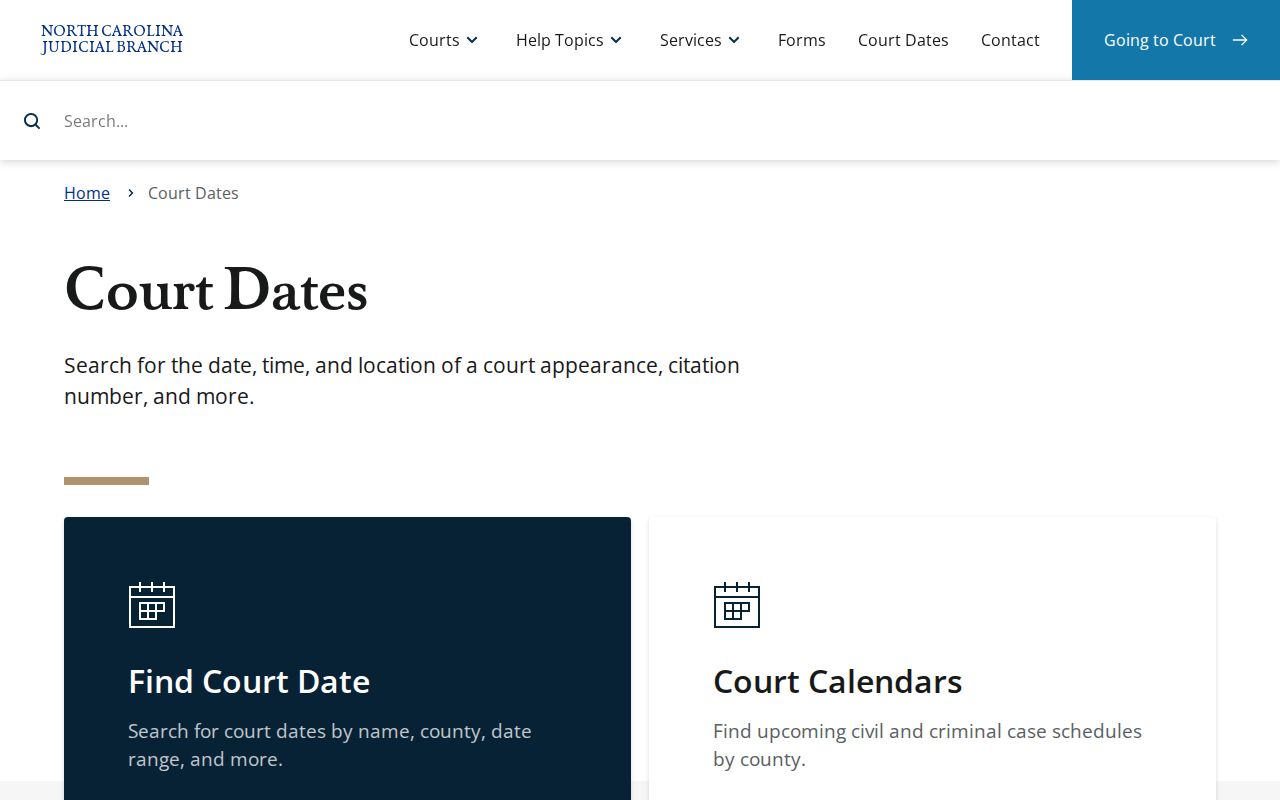
The official North Carolina court-dates search can supply scheduling information. Its captured interface appears below, but a calendar result must still be checked against the docket and later judgment.
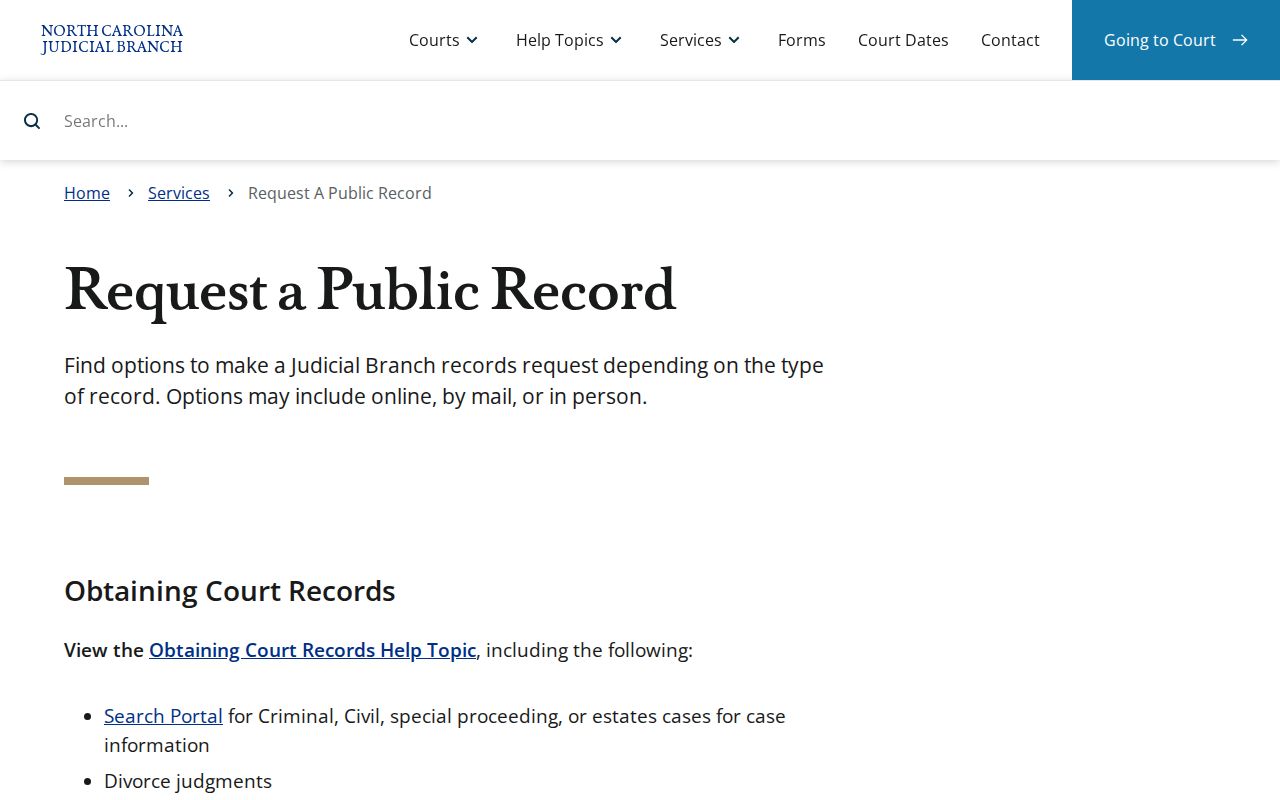
If neither Portal nor the calendar resolves the issue, contact the clerk. For court administrative records rather than a case file, use the Judicial Branch public-record request. The source capture below shows that separate request route.
Keeping the channels separate avoids sending a case-file request to an administrative-record office that does not hold it.
Access Rules for Case Records
G.S. 7A-109 makes clerks custodians of court records and provides for inspection and copies subject to law. That open-access rule does not expose every item. Sealed cases, juvenile matters, protected identifiers, confidential records, and nonpublic document images can be omitted from public Portal views and restricted at the counter.
Online redaction and a courthouse file are not always the same access tier. Ask the Mitchell County clerk what is public, what has been sealed, and whether an order or special request process controls access. For the broad county criminal-history context, the Mitchell County criminal records overview explains how court files differ from agency, repository, and correction records.
Note: A same-name case result should be matched with case details before it is attributed to a person.