
Mitchell County Criminal History Checks
Begin with the kind of record, not just a name. North Carolina eCourts holds public case information for Mitchell County, while the Clerk of Superior Court supplies courthouse files and certified searches. The Sheriff keeps records created by its deputies. Spruce Pine Police keeps city reports. A receiving jail keeps its own booking record, and the North Carolina State Bureau of Investigation keeps fingerprint-linked state history. Gather a full legal name, prior spellings, an approximate date, the agency, and any case or report number. A birth date can help distinguish two people with the same name, but a name match alone is not proof of identity. Use this order:
- Search eCourts by party name or case number, then narrow the location to Mitchell County and the case type to criminal.
- Compare the case number, filing date, charge, and court location before opening the event timeline.
- Call the Sheriff when the question involves a recent arrest, warrant, incident report, or the location of a person in custody.
- Ask the clerk to inspect the court file or run a certified search when an official court result is needed.
- Use SBI Right to Review to inspect your own fingerprint-based North Carolina history and challenge a repository error.
The official courthouse listing shows the local court building and visitor details.
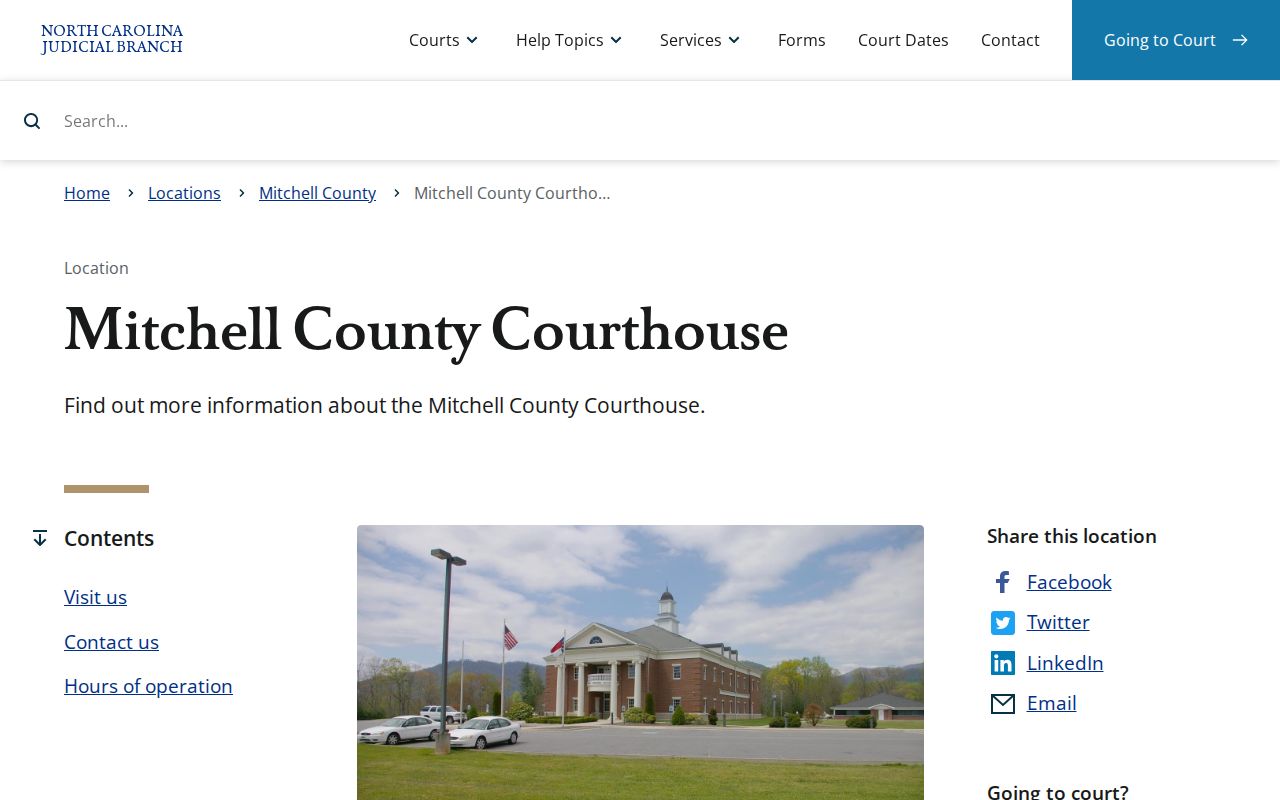
The courthouse remains the key source when a portal result needs a certified record, a paper file, or clerk review.
Mitchell County eCourts Record Search
The North Carolina eCourts Portal became Mitchell County's working electronic case system during the 2025 rollout. Smart Search is free for public case information. It can show a case number, parties, case status, hearings, financial entries, and a timeline. It is still an information service, not a certified court record. Sealed matters, juvenile cases, protected data, and some document images do not appear.
Search broadly first, then narrow. Spelling differences can hide a result, and the same name can produce several unrelated cases. The official fields help keep the search tied to Mitchell County criminal records.
| Portal control | How to use it | Why it matters |
|---|---|---|
| Search Criteria | Enter a party name or case number | A case number is the most exact route |
| Location | Select Mitchell County | Removes most same-name cases elsewhere |
| Case category | Choose criminal when available | Separates criminal cases from civil files |
| Status and date | Narrow after the first result | Helps locate older or pending matters |
Use a Mitchell courthouse terminal if Smart Search misses an older matter. The clerk can also check the stored file and explain how to obtain a certified copy.
Note: Portal event listings support a first search, while certified Mitchell County criminal records still come from the clerk.
Official Background Checks in North Carolina
North Carolina does not offer the public an SBI name-search portal for complete rap sheets. For personal review, the official route is the SBI Right to Review process. The person submits a current form, ten legible fingerprints, and approved payment. Local law enforcement provides fingerprinting, since SBI no longer sends blank FD-258 cards. The state response is North Carolina-only and is not a certified court search.
A Mitchell County clerk search answers a different question. The clerk checks court indexes statewide and can certify the result. The FBI also permits a person to request an Identity History Summary using fingerprints. Each channel has distinct coverage.
| Official record | Published fee | Main scope |
|---|---|---|
| SBI Right to Review | $14 | One's own fingerprint-based North Carolina history |
| Clerk certified search | $25 | Certified statewide court-index search |
| State and national fingerprint check | $38 | Available only where state law authorizes it |
| FBI direct self-review | $18 | Federal Identity History Summary |
The SBI repository overview explains how fingerprint and disposition data are maintained.
This repository is person-based, unlike the clerk's case-based court index.
Mitchell County Criminal Record Trail
One incident can leave records at four or five stops. The arresting agency writes the incident or arrest report. A receiving facility creates intake data and takes fingerprints. A magistrate and the court create process, charges, hearings, and judgment entries. Fingerprints may start an SBI arrest cycle, and the clerk later reports a disposition for association with that cycle.
The useful flow is: Agency report → receiving-jail booking → Mitchell court case → SBI fingerprint history. NCDAC becomes another stop if the judgment results in state prison, probation, parole, or post-release supervision.
These records do not always update at once. A recent arrest may predate a visible case. A court charge can differ from the charge at arrest because a prosecutor may amend, replace, or dismiss it. Missing fingerprints, delayed disposition reports, expunction processing, and spelling differences can also create gaps. Compare source dates and identifiers instead of treating one screen as the whole Mitchell County criminal history.
Note: An arrest or pending charge is an allegation, not proof of guilt or a final court result.
Kinds of Criminal Records
Criminal record is a broad label. In Mitchell County, the custodian depends on what happened and which agency made the file. A report may exist without an arrest. A booking record may be held in another county. A registry entry has a narrow statutory purpose and is not a complete criminal history.
- Incident report
- An agency record of an alleged event, with some investigative detail restricted by law.
- Arrest record
- The officer's record of taking a person into custody and the charges alleged at that time.
- Booking record
- The receiving facility's intake record, which may include identifiers, fingerprints, bond, holds, and release data.
- Court case file
- The prosecution record, including filed charges, hearings, pleas, disposition, judgment, costs, and sentence.
- SBI arrest cycle
- A fingerprint-indexed state entry that links an arrest to a reported disposition when the records match.
Warrants form another record class. Mitchell County has no verified public warrant database or official app list. Call the Sheriff or the magistrate for safe routing, and use eCourts for any public case events. An online absence does not prove that no judicial process exists.
Note: Ask for the named record itself because an agency need not create a new criminal-history summary.
Mitchell County Jail Record Gap
An official Mitchell County assessment states that the county has no jail and that people are often housed in McDowell County. County minutes trace the gap to a 2002 jail fire and later planning for a replacement. They also describe daily out-of-county transport, two courthouse holding cells, and help from Yancey County.
This history explains why there is no defensible Mitchell County inmate roster to search. Call the Sheriff first. Ask which agency made the arrest and which facility received the person. Then use that facility's official phone or roster. Do not assume every person goes to McDowell, because the receiving site must be confirmed case by case.
Avery-Mitchell Correctional Institution in Spruce Pine is a state prison, not the county jail. A newly arrested person should not be sought there unless officials confirm state custody. That distinction prevents a common Mitchell County record-search error.
Mitchell County Criminal Records: What They Contain
Fields change by source. A court file focuses on a case, a police report focuses on an event, and an SBI response focuses on a fingerprint-linked person. Read the label and date beside each field. A charge at arrest may not match the final court charge, and a blank disposition does not establish guilt.
| Name and identifiers | Legal name, aliases, date-of-birth data, state or FBI number where that source may release it |
|---|---|
| Arrest and booking | Arrest date, agency, alleged charges, receiving facility, bond, holds, and release or transfer details |
| Court charge | Case number, offense text, statute, class, offense date, and the charge pursued in court |
| Disposition | Pending, dismissed, not guilty, guilty, or another recorded outcome |
| Sentence | Custody, probation, costs, fines, and conditions at the detail the public source provides |
| Supervision | Current or historical state prison, probation, parole, or post-release information where public |
The official North Carolina registry provides a separate statutory record source.
A registry profile supports community awareness, but it does not replace the court file or a full fingerprint record.
Mitchell County Custody Record Search
State custody and county booking are not the same. Once a court sends a person to the North Carolina Department of Adult Correction, the official Offender Public Information/Search system, often called OPUS, may show an offender number, status, location, conviction offense, county of conviction, sentence dates, release dates, and public supervision history. It can also help check probation or post-release status.
The NCDAC Offender Search offers both offender-number and name fields.
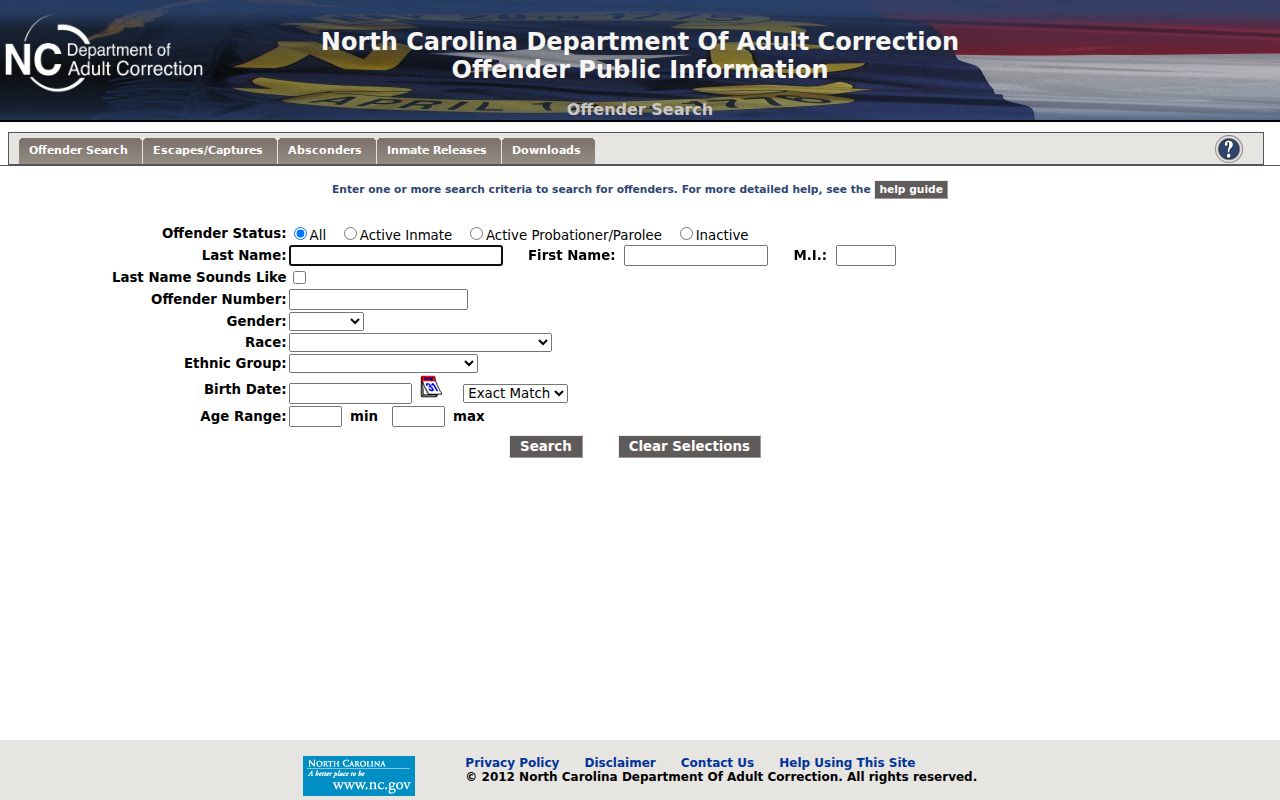
Use the offender number when known. For a name search, narrow by first name, race, gender, birth date, or age only through the fields the portal supplies, then compare the Mitchell County conviction and sentence dates with the court judgment.
OPUS does not replace the judgment. It may omit confidential classification or institutional details. When a person was arrested recently and has not been sentenced to state custody, return to the Mitchell Sheriff and the identified receiving jail.
Note: A state-prison result does not identify the out-of-county jail that handled an earlier Mitchell County booking.
North Carolina Public Access Laws
The North Carolina Public Records Law begins with broad access to government records, but the rule has limits. Ask for an existing, identifiable record in the desired format. An office need not create a new criminal-history compilation. The Sheriff can release specified public incident and arrest categories while withholding protected investigative material, victim data, juvenile information, or active evidence. Court case records follow clerk and Judicial Branch rules.
Key North Carolina laws:
G.S. 132-1 defines public records across many forms.
G.S. 132-6 provides for inspection and copies at reasonable times.
G.S. 132-6.2 controls actual-cost copy fees and certain special service charges.
G.S. 132-1.4 separates public arrest facts from protected investigative files.
G.S. 7A-109 makes clerks custodians of court records, subject to law.
Copies may cost money, but Mitchell County does not post a general Sheriff report fee schedule. Confirm the format, amount, and payment method before ordering. If an office denies access, ask for the legal basis. Body-camera recordings and 911 material follow added disclosure, privacy, retention, and redaction rules.
Mitchell County Sheriff Record Route
The Mitchell County Sheriff's Office at 305 Baker Lane in Bakersville is the first contact for sheriff incident reports, arrest records, warrant routing, and the location of a recent detainee. Call 828-688-3982. If unanswered, the county lists 828-688-9974. The office provides 24-hour operations, with listed office help from 8:00 a.m. to 7:00 p.m.
State the event date, location, creating agency, report or case number, record type, and preferred format. Ask whether the Sheriff owns the requested item. A Spruce Pine police report stays with city police, a receiving jail owns its booking record, and the clerk owns pleadings and judgments. For CAD or 911 audio, contact Mitchell County Communications at 117 Long View Drive, 828-688-9110.
Mitchell County Sheriff
305 Baker Lane
Bakersville, NC 28705
828-688-3982
Clerk of Superior Court
328 Longview Drive
Bakersville, NC 28705
828-688-5100
Trust the county's address. Its Sheriff page warns that online maps had labeled the Baker Lane building as a former apparel business.
Note: Call before travel during mountain storms or emergency recovery, when normal Mitchell County office access may change.
Restricted, Sealed & Expunged Records
Juvenile files, sealed cases, protected identifiers, and confidential investigative material do not become public merely because other Mitchell County criminal records are open. North Carolina uses the term expunction for the statutory process that clears qualifying public entries. File a Mitchell County petition with the Clerk of Superior Court when the local court handled the case, using the current form for the exact law.
G.S. 15A-146 covers qualifying dismissals and not-guilty results. Certain cases disposed on or after December 1, 2021 may be automatically expunged after 180 to 210 days, subject to exceptions. G.S. 15A-145.5 governs eligible nonviolent misdemeanor and felony convictions, with exclusions, count limits, and waiting rules. DWI and many violent or sexual offenses are excluded.
Automatic does not mean instant. Keep the case number and certified disposition. Check the court index, the arresting agency, and your SBI record after processing. A public search may lag, and law can permit limited confidential agency files to remain.
Mitchell County Expunction Record Flow
Start with the complete Mitchell County case number and disposition. Read the current eligibility subsection, confirm sentence completion and any waiting period, then file the proper AOC petition with fee or indigency papers if the statute requires them. Some petitions involve review by the district attorney or SBI, and some require a hearing.
After an order, the clerk sends notice through the state process to the Administrative Office of the Courts and named state or local agencies. That notice route is why one printed order can affect several record systems. It also explains why a cached or separate file may not vanish on the same day.
If the information is accurate but eligible for clearing, use expunction. If an SBI arrest cycle is wrong, use the repository's challenge process with a certified court disposition. Mistaken identity has its own route under G.S. 15A-147. Keep a certified copy of any order and recheck each source that once displayed the Mitchell County record.
City-by-City Criminal Records in Mitchell County
Mitchell County has only two incorporated municipalities. Spruce Pine is the largest and has a municipal police department, so city-created reports begin with that agency. Bakersville is the county seat, where the Sheriff, courthouse, and 911 center cluster, but there is no separate municipal criminal court database. Cases from both towns enter North Carolina's unified District and Superior Courts in Mitchell County.
Spruce Pine Record Check
2024 estimate: 2,192. Police reports start with Spruce Pine Police; criminal cases appear under Mitchell County.
Bakersville Record Check
2024 estimate: 443. County court and sheriff records are centered in Bakersville, while custody may be elsewhere.
For either town, first identify who created the record. Then trace any booking to the receiving facility and any filed criminal case to the Mitchell County clerk or eCourts.
Mitchell County Federal Criminal Records
Federal matters do not appear in North Carolina eCourts. Mitchell County lies in the U.S. District Court for the Western District of North Carolina. Federal court dockets use PACER, while a person serving a federal sentence is checked through the Federal Bureau of Prisons locator. These systems are separate from the Mitchell County clerk, the Sheriff, SBI, and NCDAC.
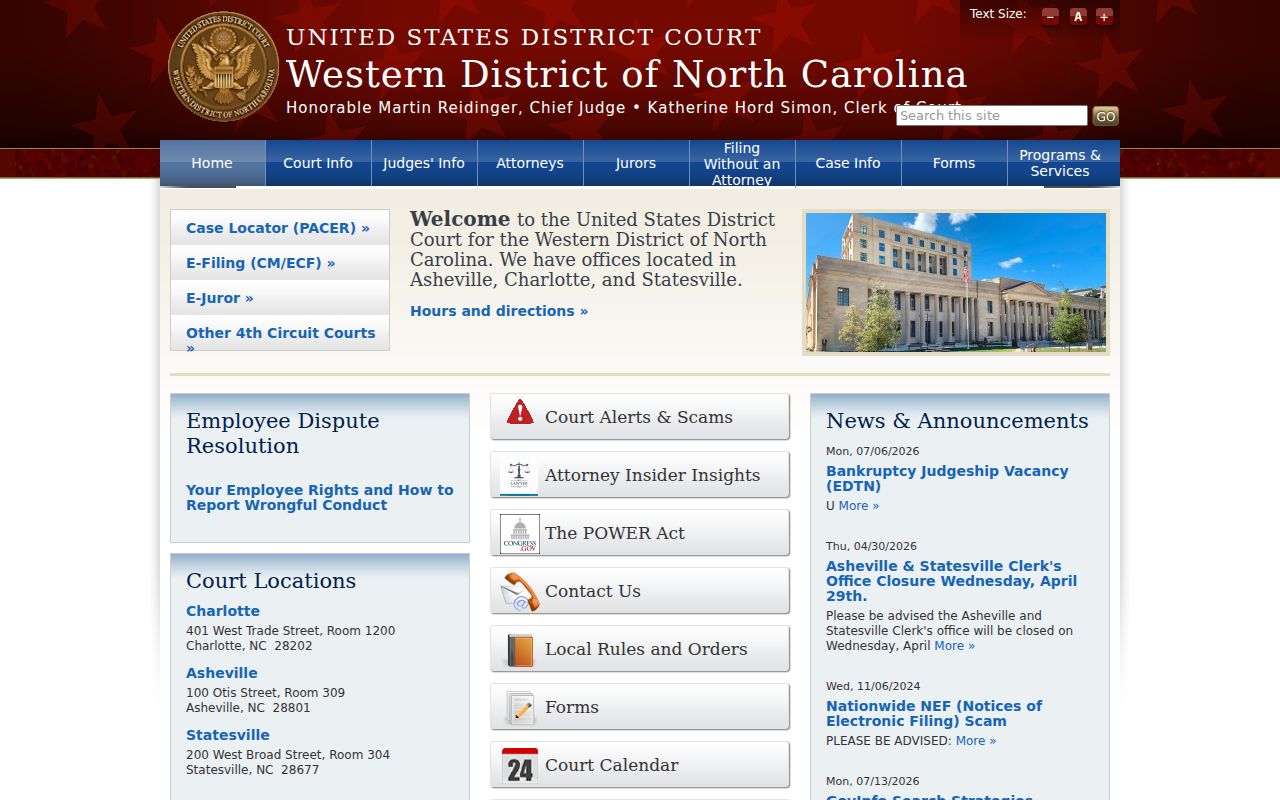
The Western District's official source identifies the federal court and its services.
A local address or arrest does not by itself show whether a matter is state or federal. Confirm the charging court before choosing a database.
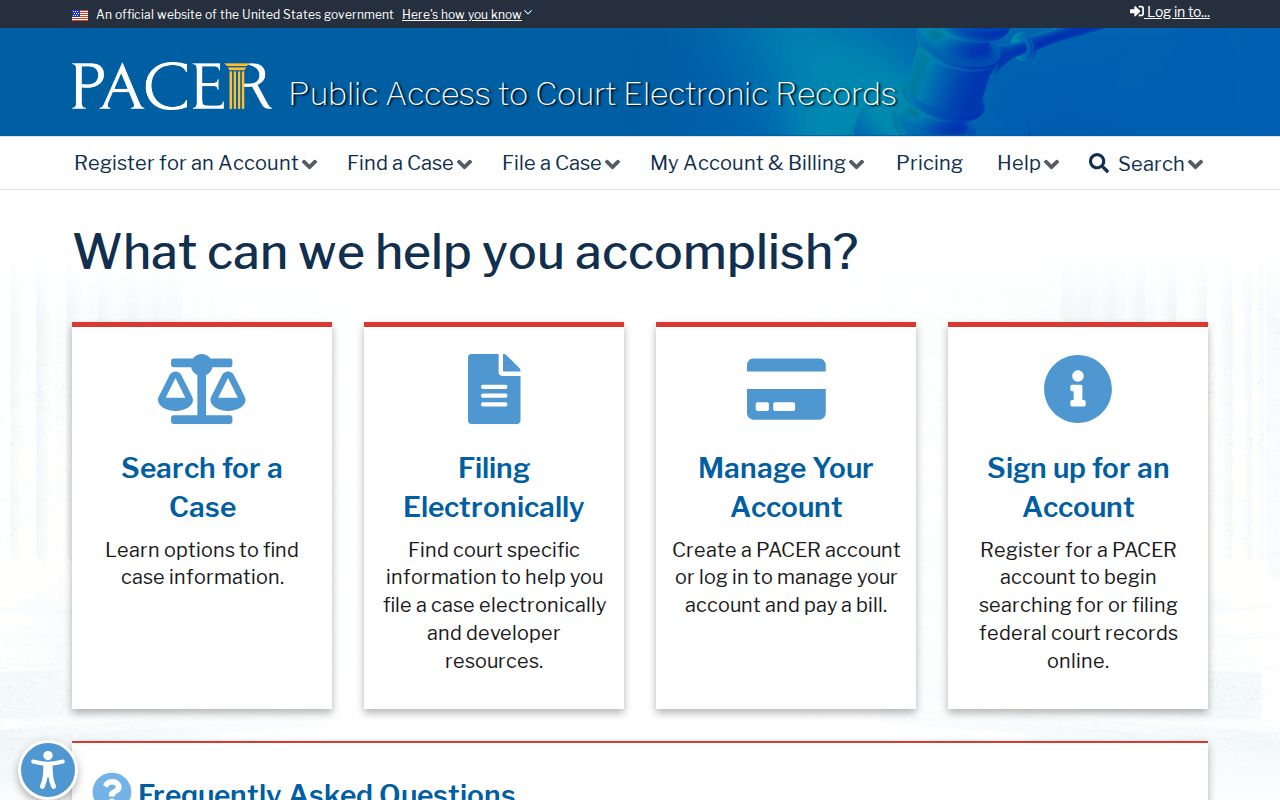
The official PACER service searches federal dockets by court, case number, party, filing dates, and case type.
PACER generally charges by the page under its current schedule, and sealed federal matters are not public. Compare the docket number, court, filing date, and party details before relying on a result.